
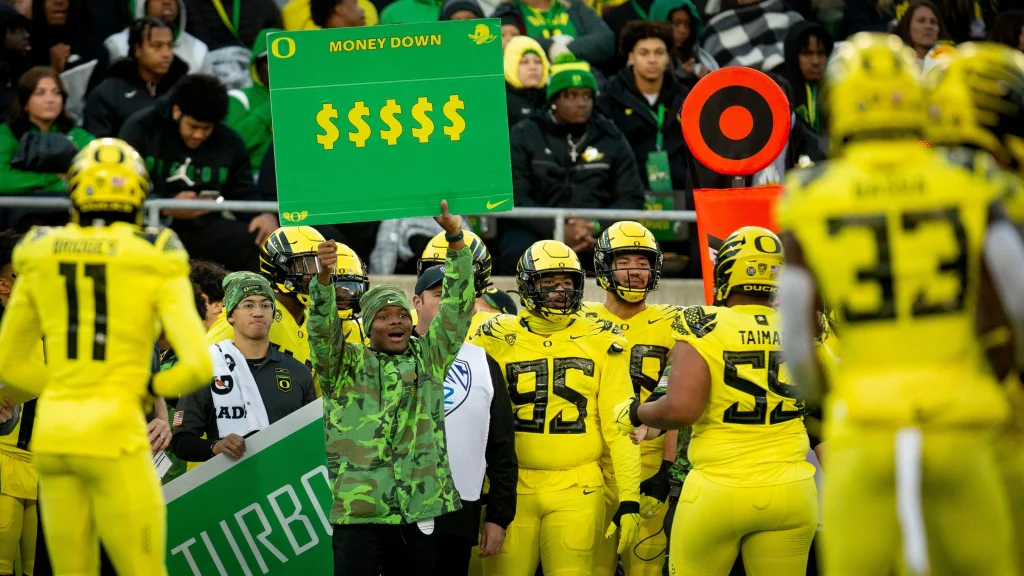
The landscape of college football has undergone a seismic shift due to recent conference realignments, with significant financial implications for the schools involved. Here’s a comprehensive overview of the changes and their impacts:
Major Conference Shifts
SEC Expansion
The Southeastern Conference (SEC) has bolstered its ranks by adding Texas and Oklahoma, two powerhouse programs leaving the Big 12. This strategic move is projected to increase their annual revenue by approximately $30-35 million per school. The SEC’s dominance in college football is set to grow even further, promising thrilling matchups and heightened competition.
Big Ten Growth
The Big Ten’s expansion to 18 schools, including USC, UCLA, Oregon, and Washington, marks a historic shift. USC and UCLA, in particular, are seeing an increase of around $62-67 million in annual revenue per school. This move not only enhances the conference’s competitive edge but also its media market reach, spanning from coast to coast.
ACC Changes
The Atlantic Coast Conference (ACC) has welcomed Cal, Stanford, and SMU into its fold. Stanford and Cal are experiencing a revenue boost of approximately $12-17 million annually, while SMU sees an increase of about $25-30 million. These additions bring new dimensions to the ACC, both in terms of athletic prowess and academic prestige.
Big 12 Adaptation
In response to the shifting landscape, the Big 12 has added Arizona, Arizona State, Utah, and Colorado. These schools are seeing an increase of approximately $27-32 million in annual revenue. The Big 12’s proactive approach ensures its relevance and competitiveness in the evolving college football ecosystem.
Pac-12 Dissolution
The once-mighty Pac-12 conference has essentially dissolved, left with only two schools: Oregon State and Washington State. This downfall was precipitated by the loss of 10 out of 12 member schools to other conferences and the failure to secure a lucrative new media rights agreement. The Pac-12’s demise serves as a cautionary tale of the volatile nature of college athletics.
Financial Implications
Media Rights Deals
- SEC: Approximately $1.5 billion annually, or $75-80 million per school.
- Big Ten: $1.4 billion annually, translating to about $85-90 million per school.
- ACC: $300 million annually, roughly $35-40 million per school.
- Big 12: Provides $50-55 million per school annually.
These lucrative media deals are the driving force behind the realignments, reshaping the financial landscape of college athletics.
Impact on Schools
Increased revenue allows for enhancements in facilities, recruiting, and overall competitiveness. Some schools, like SMU in the ACC, agreed to reduced revenue shares initially to join more prestigious conferences. This strategic sacrifice is expected to pay off in the long run with greater exposure and opportunities.
Conference Structures
Divisions and Scheduling
Starting in 2024, the SEC and Big Ten will not have divisions. The SEC will play eight conference games, while the Big Ten will continue with nine. The top two teams in each conference will meet in their respective championship games.
Group of 5 and Independents
- The American Athletic Conference (AAC) added Army but lost SMU.
- Conference USA added Kennesaw State, bringing its total to 10 teams.
- Only three independents remain: Notre Dame, UConn, and UMass.
Broader Impact
The realignment has led to the end of the traditional “Power Five” structure in college football. Increased travel distances may affect student-athletes’ well-being and academic performance. The changes are primarily driven by lucrative TV deals and media rights, reshaping the financial landscape of college athletics.
This realignment represents a significant shift in college football, with financial considerations playing a crucial role in shaping the new conference structures. The moves reflect a strategic pursuit of greater financial gains, driven by the more lucrative media deals of the major conferences, impacting each school’s ability to enhance its program and overall competitiveness.
It gets hairy for the ACC: If/When FSU and Clemson depart
If Florida State and Clemson succeed in leaving the ACC, the implications would be profound for both the conference and the broader landscape of college football. Here are some key points to consider:
Financial Impact
ACC Revenue Loss
- Florida State and Clemson are two of the ACC’s most valuable brands. Their departure would significantly reduce the conference’s appeal to media partners, potentially leading to a decrease in the value of the ACC’s media rights deal.
- The ACC currently earns approximately $300 million annually from its media rights, translating to about $35-40 million per school. Losing these two schools could lead to a renegotiation of this deal, likely at a lower value.
Increased Revenue for New Conferences
- If Florida State and Clemson join a more lucrative conference like the SEC or Big Ten, they could see a substantial increase in their annual revenue. The SEC and Big Ten currently distribute around $75-90 million per school annually from their media rights deals.
Competitive Balance
ACC Competitiveness
- The departure of Florida State and Clemson would weaken the ACC’s competitive standing in college football. These schools have been consistent contenders for national championships and their absence would diminish the conference’s overall competitiveness.
Strengthening of New Conferences
- Adding Florida State and Clemson would bolster the competitive strength of any conference they join. This could lead to even more intense competition in the SEC or Big Ten, making these conferences even more dominant in college football.
Legal and Contractual Issues
Grant of Rights
- Both schools would need to navigate the ACC’s grant of rights agreement, which binds member schools’ media rights to the conference until 2036. This could involve legal battles over exit fees and the control of broadcasting rights.
- Clemson and Florida State have already initiated legal actions challenging the ACC’s control over their media rights and the enforceability of the exit fee, which is reportedly around $140 million.
- Understanding the Grant of Rights: An Overview: A Grant of Rights is a legal document that consolidates the media rights of member programs within a conference, allowing the conference to negotiate and sell these rights to broadcasters. The revenue generated from these deals is then distributed to member programs, typically on a pro-rata basis. This arrangement not only creates a revenue stream for the programs but also binds them contractually, making it challenging for any member to exit the conference.
- The ACC’s “Ironclad” Grant of Rights
- Recent high-profile moves, like Texas and Oklahoma’s departure from the Big 12, highlight the significance of Grant of Rights agreements. The ACC’s Grant of Rights, however, stands out for its stringent terms. Modeled after the Big 12’s agreement, the ACC’s version is reportedly “ironclad,” incorporating provisions that favor the conference in legal disputes. This means that any legal challenges would be heard in a federal court that is likely more favorable to the ACC rather than a state court that might be sympathetic to a departing member.
- The financial penalties for exiting the ACC are substantial, with estimates placing the exit fee at around $120 million—roughly three years’ worth of revenue. This is notably higher compared to the combined $100 million exit cost faced by Texas and Oklahoma from the Big 12.
- Despite the strong contractual and financial barriers, the ACC is adapting to maintain its competitive edge. The conference recently introduced a merit-based compensation structure aimed at increasing revenue for teams that excel in major competitions, such as the College Football Playoff and NCAA Tournament. This move is designed to bolster the financial standing of top programs within the ACC, helping them remain competitive with peers in the Big Ten and SEC.
Broader Implications
Conference Realignment
- The departure of Florida State and Clemson could trigger further realignment across college football. Other schools may seek to leave the ACC or other conferences to join more financially stable and competitive leagues.
- This could lead to a reshuffling of the “Power Five” conferences, potentially creating new power dynamics in college football.
Impact on Student-Athletes
- Increased travel distances and the pressure to compete at higher levels could affect student-athletes’ well-being and academic performance. The demands of playing in a more competitive conference could also impact recruitment and retention of top talent.
Summarizing FSU and Clemson’s Impact on the ACC
The potential departure of Florida State and Clemson from the ACC would have far-reaching consequences, reshaping the financial, competitive, and structural landscape of college football. It underscores the growing influence of media rights deals and financial considerations in the sport, highlighting the ongoing evolution of college athletics.
Closing Thoughts
As college football continues to evolve amidst unprecedented conference realignments, the intricate interplay of media rights deals and financial stakes has never been more pivotal. The potential departure of powerhouse programs like Florida State and Clemson from the ACC not only threatens to upend the conference’s financial equilibrium but also to recalibrate the competitive and structural dynamics across the sport.
This unfolding drama underscores the profound impact of media agreements and revenue models on the future of college athletics, signaling a transformative era where financial considerations drive the strategic decisions of top-tier programs. To grasp the full scope of these shifts and their implications, diving deeper into the evolving landscape of college football and its financial frameworks will be essential for understanding the sport’s next chapter. We recommend Front Office Sports, the NCAA’s official website, official conference sites, the USA Today’s College Athletics database, and trusted content from ESPN investigative reporting and Sports Reference as excellent sources.
And of course, Packed House Sports! Be well!