
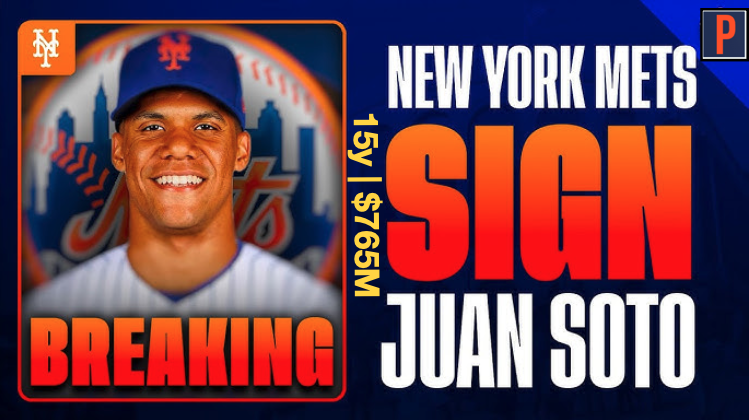
The numbers are staggering. Fifteen years, $765 million, with no deferred money. Juan Soto’s blockbuster contract with the New York Mets, agreed to late Sunday night, doesn’t just rewrite the record books — it reshapes the landscape of Major League Baseball and announces the Mets as a true contender in both the NL East and the wider baseball world. It also signals a major shift in the way we view ownership, team-building, and the free-agent market.
Juan Soto: A Baseball Phenomenon
Juan Soto’s journey from a 19-year-old phenom to the most sought-after free agent in baseball has been nothing short of remarkable. Since making his MLB debut in 2018, Soto has been a fixture in the conversation about the game’s best young talents and hitters. Known for his exceptional plate discipline, power, and ability to perform under pressure, Soto had already shown his worth in postseason play before ever hitting the open market. His decision to turn down a $440 million contract extension from the Washington Nationals two years ago only raised his profile, positioning him as one of the few players in the game who could command a deal of this magnitude.
By opting for free agency, Soto bet on himself — and now, he stands as the face of baseball’s new financial reality. At just 26 years old, he’s in the prime of his career, and his potential is seemingly limitless. His decision to sign with the Mets over the New York Yankees — a team he had helped guide to a World Series appearance in 2024 — is a seismic shift in the balance of power in the sport.
The Mets’ Transformation: A New Era in Queens
While Soto’s massive deal is a testament to his talent, it’s also a reflection of the transformation the New York Mets have undergone under the ownership of Steve Cohen. The Mets, long the second team in New York behind the Yankees, are no longer the perennial underachievers they once were. With Cohen’s $20 billion fortune, the Mets have positioned themselves as a behemoth in the financial arms race that defines modern MLB.
Cohen’s purchase of the team in 2020 marked the beginning of a bold new era for the Mets. Early failures, such as missing out on top free agents and struggling with roster mismanagement, have given way to decisive moves. The acquisitions of Francisco Lindor and Carlos Carrasco, the hiring of president of baseball operations David Stearns, and the promotion of manager Carlos Mendoza have provided the franchise with a sense of stability and vision.
Signing Soto — for a contract that dwarfs those of Shohei Ohtani or Patrick Mahomes — represents the culmination of Cohen’s commitment to building a perennial contender. Unlike previous owners who may have been hesitant to spend, Cohen has been unafraid to invest in top talent, and Soto’s arrival is the latest signal that the Mets are all-in. With Soto joining forces with Lindor and budding stars like Mark Vientos, the Mets are now positioned to challenge the juggernauts of the NL and beyond.
The Impact on Team Dynamics: Is This the Missing Piece?
Soto’s addition to the Mets’ lineup brings with it a host of implications, both immediate and long-term. On paper, a 1-2 punch of Soto and Lindor atop the lineup is among the most fearsome in all of baseball, rivaling the best combinations in Los Angeles, Atlanta, or even San Diego. The Mets now boast a left-handed power hitter who can anchor the middle of the order for the next decade and a half — an era-defining acquisition.
But as much as Soto improves the Mets’ offense, his contract will inevitably influence the broader team dynamics. First and foremost, the Mets will be under immense pressure to build a roster that can live up to Soto’s staggering price tag. While the Mets’ financial flexibility is unmatched, their payroll could soon exceed that of the Los Angeles Dodgers, with a luxury tax bill to match. This puts a premium on other key roster decisions, such as retaining top talent (e.g., Edwin Diaz, Francisco Alvarez, Brandon Nimmo) while continuing to strengthen the pitching staff.
It also raises questions about how the Mets will balance their roster going forward. While their starting lineup is shaping up to be one of the league’s best, their pitching depth, especially in the bullpen, remains a work in progress. Cohen has demonstrated that he’s willing to spend lavishly, but the challenge will be creating a balanced roster that doesn’t rely too heavily on a few star players.
The team will also need to manage its young talent — notably prospects like Vientos and Alvarez — and determine how to build around them while still maintaining financial flexibility. With Soto’s deal dominating the payroll, the Mets may face tough decisions when it comes to extending or trading other assets, particularly if they’re looking to add complementary pieces to the roster.
The Long-Term Implications: What’s Next for the Mets and MLB?
While the deal is a win for the Mets and Soto, it raises significant questions about the future of MLB’s free-agent market. Soto’s $765 million contract is the largest in professional sports history, surpassing even the previous record set by Shohei Ohtani with the Los Angeles Dodgers. His deal signals that the bar for elite talent has been raised — and not just incrementally, but by a substantial margin. Soto, a 26-year-old with already proven postseason success, was always going to command a huge payday, but the scale of this deal is indicative of the changing economics of the sport.
The deal also signals a shift in how MLB teams will approach free agency. While teams like the Yankees and Red Sox have traditionally been the big spenders, Cohen’s willingness to outbid even them suggests a new, more aggressive model of team-building. With a multi-billionaire at the helm, the Mets are no longer competing within the confines of traditional baseball economics. Instead, they’re rewriting the playbook on how to build a team — one that combines top-tier talent with a willingness to make enormous financial commitments. Other owners will have to follow suit or risk being left behind.
On a larger scale, Soto’s deal could have a ripple effect across the industry, particularly in terms of the younger talent entering the market. As Soto’s contract shows, teams are now more willing than ever to extend massive deals to players entering their prime. This could lead to more aggressive approaches to locking down younger stars before they hit free agency, reshaping the way teams build their core talent moving forward.
A New Standard for the New York Mets
Juan Soto’s $765 million contract with the Mets isn’t just a financial windfall for the player; it’s a statement about the future of the franchise. With Steve Cohen at the helm, the Mets are no longer second-class citizens in New York — they’re a true powerhouse, capable of not just competing with the Yankees, but surpassing them in both talent and financial clout.
For Mets fans, this marks the beginning of what could be a golden era of baseball. The foundation is set, the stars are aligned, and the possibilities are endless. In an era where free agency is often a gamble, Soto represents the sure thing, and the Mets have made their move. As the 2025 season looms, all eyes will be on Queens — where the future of the New York Mets is being written in record-breaking ink.